
The Concept of Clunky Narratives
In ordinary usage, “clunky” is a fault. It describes a sentence that stumbles, dialogue that sounds stiff, a paragraph carrying more words than it needs. Most writing advice tells you to edit it out, and most of the time that advice is right.
This page is about the other case: when the stumble is the point.
What a Clunky Narrative Is
A clunky narrative is one that intentionally shows its seams. The line doesn’t quite scan, the register shifts mid-stanza, or a traditional form gets forcefully stretched around a subject it was never originally built to hold. While conventional editing structures try to smooth that friction away, Skendong Poetry intentionally keeps it in.
That is a deliberate creative bet, not an accident. Fluency can easily flatten a poem—it lets a reader glide right past the hard, jagged edges of a subject instead of forcing them to stumble and take notice. A sudden jump-cut line, an awkward rhyme, or a register that lurches violently from biblical prophecy to a bitcoin joke are not failures of control. They are the exact friction points where the poem forces you to slow down and actively look at what it is doing.
Where it Comes From
This clunkiness is never uniform; the register is chosen per poem to leave the underlying machinery visible. In “Firewave,” the text tightens into a villanelle, circling its environmental crisis until the repetitive form itself collapses at the end under the sheer weight of destruction. In contrast, a piece on gentrification like “Erst” stays loose and observational, stepping aside to let the items on a local restaurant menu do the arguing. In “The Bad Sentient,” exploring a rogue AI, the text pivots entirely into a sharp, comic sonnet because the digital news cycle is already halfway to farce.
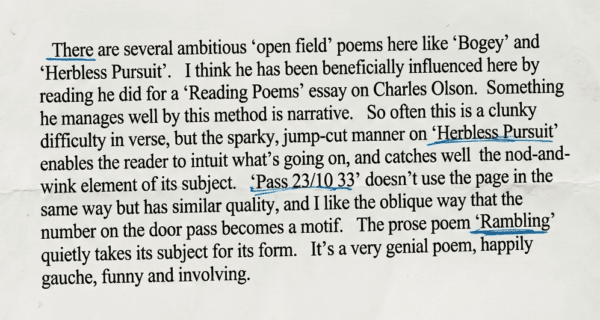
Poet, critic, and translator Jeffrey Wainwright observed this approach in 2003, noting that narrative is so often a “clunky difficulty in verse,” but that the “sparky, jump-cut manner” of Herbless Pursuit let the reader intuit what was going on while catching the “nod-and-wink” element of its subject. That observation anticipated many of the storytelling techniques that would later develop into what Skendong describes as Clunky Narratives.
What It Is Not
This approach is not sloppiness dressed up in a fancy name. A clunky narrative must actively earn its friction—an awkward line has to achieve something a smooth, predictable one couldn’t, or it is simply a bad line. The true test of the work is never “does this feel unpolished,” but rather “does that lack of polish carry actual intellectual weight.”
Why It Matters Here
Manchester’s own modern poetry tradition—shaped by the Manchester Writing School and figures like Simon Armitage and Carol Ann Duffy—has never been precious about allowing blunt, plain speech to disrupt a poem. Clunky narratives extend that lineage into the digital age.
This is storytelling reimagined as a space of transformation. It is writing that explicitly refuses to pretend that the world it describes—whether dealing with localized AI anxieties, a canal-side wine bar in Ancoats, or a tragic headline out of Gaza—is any tidier, cleaner, or more resolved than it actually is.
The framework has been applied across over a decade of poems and prose, browsable by subject or by year.